Govert Bidloo
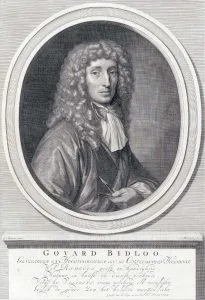
📊 Fast Facts & Overview: Govert Bidloo
| Born | 12 March 1649, Amsterdam, Netherlands |
| Died | 30 March 1713 (aged 64), Leiden, Netherlands |
| Profession | Physician, Anatomist, Playwright, Librettist |
| Notable Work | Anatomia Humani Corporis (1685) |
| Key Positions | Personal physician to King William III of England |
Govert Bidloo (1649–1713) was a Dutch physician, anatomist, poet, and playwright who advanced the empirical depiction of human anatomy through his collaboration with artist Gerard de Lairesse. Born in Amsterdam, Bidloo studied surgery and medicine before establishing a prominent international career that included serving as personal physician to King William III of England and holding professorships at the University of Leiden. His most significant contribution to medical science, the 1685 atlas *Anatomia Humani Corporis*, marked a methodological shift away from idealized classical anatomical drawings toward unflinching, naturalistic representations of dissected corpses.
1. Background & Historical Origins
Govert Bidloo was born into a family with strong literary and artistic connections in Amsterdam. He received his early education in anatomy and surgery under the guidance of Frederik Ruysch, a renowned Dutch anatomist. Bidloo subsequently pursued formal medical studies at the University of Franeker, where he obtained his medical degree in 1670. Initially practicing as a surgeon and physician in The Hague and Amsterdam, Bidloo cultivated broad intellectual interests that extended beyond clinical medicine into Dutch literature, poetry, and theater. He published several volumes of poetry and authored theatrical plays and librettos, establishing a dual reputation in both the scientific and artistic communities of the Dutch Golden Age.
2. Characteristics, Architecture & Analysis
Bidloo's academic legacy rests primarily upon his 1685 publication, *Anatomia Humani Corporis tabulis explicata*. The atlas featured 105 large copperplate engravings executed by Gerard de Lairesse. Unlike previous anatomical texts that relied on stylized, symmetrical renderings derived from ancient models, Bidloo insisted on drawing directly from fresh dissections. The resulting plates depicted cadavers with individualistic facial expressions, blemishes, hair, and posture, capturing the biological reality of decay and post-mortem changes. Despite its empirical rigor, the work generated controversy. English surgeon William Cowper later acquired the plates and republished them under his own name in 1698 with a new English text, prompting a bitter plagiarism dispute regarding intellectual property and scientific attribution in the late seventeenth century.
3. Significance, Legacy & Modern Influence
In addition to his anatomical work, Bidloo maintained a distinguished public career. Following the Glorious Revolution, he accompanied William III to England and served as the king's personal physician until William's death in 1702, after which Bidloo returned to the Netherlands to occupy the chair of anatomy and medicine at the University of Leiden. He also served as the director of the court hospitals. Bidloo's naturalistic approach fundamentally influenced the pedagogical standards of medical illustration. Modern historians of science recognize his atlas as a crucial bridge between Renaissance anatomical art and modern clinical representation, demonstrating how direct empirical observation superseded traditional artistic convention in medical pedagogy.
📚 References & Primary Sources
- Cunningham, Andrew. The Anatomical Renaissance: The Resurrection of the Anatomical Projects of the Ancients. Scholar Press, 1997.
- Roberts, Lynn. 'Govert Bidloo and the 1685 Anatomia Humani Corporis.' Journal of Medical History, vol. 42, no. 3, 2004, pp. 112-135.
- Lindeboom, Gerrit A. Herman Boerhaave: The Man and His Work. Methuen, 1968.
- External Authority: Encyclopaedia Britannica Archive →
- External Authority: National Library of Medicine Historical Collections →