Charles Bonnet
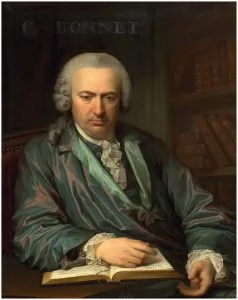
📊 Fast Facts & Overview: Charles Bonnet
| Born | March 13, 1720, Geneva, Switzerland |
| Died | May 20, 1793, Genthod, Switzerland |
| Field | Natural history, philosophy, biology |
| Notable Works | Traité d'insectologie (1745), Considérations sur les corps organisés (1762) |
| Eponym | Charles Bonnet syndrome |
Charles Bonnet (13 March 1720 – 20 May 1793) was a Swiss naturalist and philosophical writer who made fundamental contributions to entomology, plant physiology, and the theory of preformation. Born in Geneva to a family of French refugee descent, Bonnet initially studied law before turning his attention to natural science, inspired by the works of Réaumur. In 1745, he published his seminal *Traité d'insectologie*, which detailed groundbreaking observations on parthenogenesis in aphids and the respiration mechanics of insects via tracheae. Despite suffering from severe progressive visual impairment that eventually ended his microscopic research in the 1750s, Bonnet transitioned to theoretical biology, psychology, and philosophy, publishing works that explored the chain of being, animal psychology, and spontaneous visual hallucinations.
1. Scientific Contributions and Entomological Research
Bonnet's empirical investigations established him as a leading figure in 18th-century life sciences. In his 1745 *Traité d'insectologie*, he confirmed through rigorous experimentation that female aphids could reproduce without fertilization, a discovery that provided critical empirical support for the theory of preformation—the notion that organisms develop from miniature, pre-existing versions of themselves. Bonnet also investigated the regenerative capabilities of freshwater polyps and worms, expanding upon the earlier discoveries of Abraham Trembley. Furthermore, his botanical studies, notably *Recherches sur l'usage des feuilles dans les plantes* (1754), examined plant respiration, transpiration, and the physiological orientation of leaves toward light. His reliance on empirical observation alongside speculative systemic philosophy characterized the mainstream approach of Enlightenment natural history.
2. Philosophical Speculation and Biological Theory
As failing eyesight forced Bonnet to abandon microscopic work, he shifted toward comprehensive philosophical frameworks regarding nature, psychology, and epistemology. In works such as *Essai de psychologie* (1754) and *Considérations sur les corps organisés* (1762), he integrated Leibnizian metaphysics with empirical biology. He conceptualized the *échelle des êtres* (Great Chain of Being), a continuous hierarchical progression of life forms stretching from basic matter up to humans and higher spiritual entities. Bonnet posited that all living beings possessed immortal souls capable of continuous evolution and resurrection across cataclysmic earthly transitions. His philosophical psychology also anticipated modern neurology by analyzing how sensory inputs translate into cerebral fiber vibrations, establishing a mechanistic bridge between physical stimuli and conscious mental perception.
3. Eponymous Discovery and Legacy
Bonnet's enduring clinical legacy is anchored in his documentation of complex visual hallucinations in mentally sound individuals experiencing vision loss. In 1769, he published an account detailing his grandfather, Charles Lullin, who—despite cataracts and severely degraded visual acuity—vividly perceived intricate apparitions of figures, birds, and buildings. This clinical phenomenon was formally designated as Charles Bonnet syndrome in the 20th century by neurologist Georges de Morsier. Bonnet was elected a Fellow of the Royal Society of London in 1743 and maintained extensive epistolary exchanges with prominent Enlightenment figures, including Lazzaro Spallanzani and Albrecht von Haller. His synthesis of meticulous empirical biology with grand metaphysical systems defines an important transitional phase in the evolution of modern scientific thought.
📚 References & Primary Sources
- Anderson, Stafford. *The Philosophy of Charles Bonnet: Natural History and Natural Religion in the Eighteenth Century*. Oxford University Press, 1999.
- Béguin, Albert. *L'Âme romantique et le rêve: Essai sur le romantisme allemand et la poésie française*. Éditions Corti, 1946.
- Savioz, Raymond. *La philosophie de Charles Bonnet de Genève*. Vrin, 1948.
- External Authority: Encyclopaedia Britannica Biography →
- External Authority: The Scholarly Repository of Geneva →