James Arderne
📑 Table of Contents
📊 Fast Facts & Overview: James Arderne
| Birth Name | James Arderne |
| Birth Date | 1636 |
| Death Date | 18 September 1691 |
| Profession | Clergyman, Theologian |
| Notable Position | Dean of Chester (1682–1691) |
James Arderne (1636–1691) was an English clergyman, royal chaplain, and theologian who served as the Dean of Chester from 1682 until his death in 1691. Best remembered as the founder of the public library at Chester Cathedral, Arderne navigated the complex religious and political turbulence of Restoration England, leaving a permanent institutional legacy in the intellectual life of Cheshire.
(adsbygoogle = window.adsbygoogle || []).push({});
1. Background & Historical Origins
Born in Cheshire in 1636 into a prominent local family, James Arderne received a rigorous classical and theological education. He entered Christ's College, Cambridge, later migrating to St John's College, Cambridge, where he completed his academic training. Following the restoration of the monarchy in 1660, Arderne aligned himself closely with the restored Church of England and the Stuart court. His early career included serving as a curate in London and gaining recognition as an eloquent preacher, which eventually caught the attention of King Charles II. Appointed as a Chaplain in Ordinary to the King, Arderne established a reputation as a staunch defender of royal prerogative and episcopacy during an era of significant sectarian and political division.
2. Characteristics, Architecture & Analysis
Arderne’s tenure as Dean of Chester, commencing in 1682, was defined by his dedication to ecclesiastical scholarship and community education. Recognizing the dearth of accessible theological literature for the provincial clergy and laity, he conceived the establishment of a dedicated public library at Chester Cathedral. By his final will and testament dated 1690, Arderne bequeathed his entire private collection of books—comprising works on divinity, philosophy, history, and classical literature—to form the nucleus of what is now recognized as the Chester Cathedral Library. Furthermore, he allocated financial endowments for the acquisition of future texts and the maintenance of a librarian, demonstrating an advanced forward-thinking approach to institutional preservation and public access to knowledge.
3. Significance, Legacy & Modern Influence
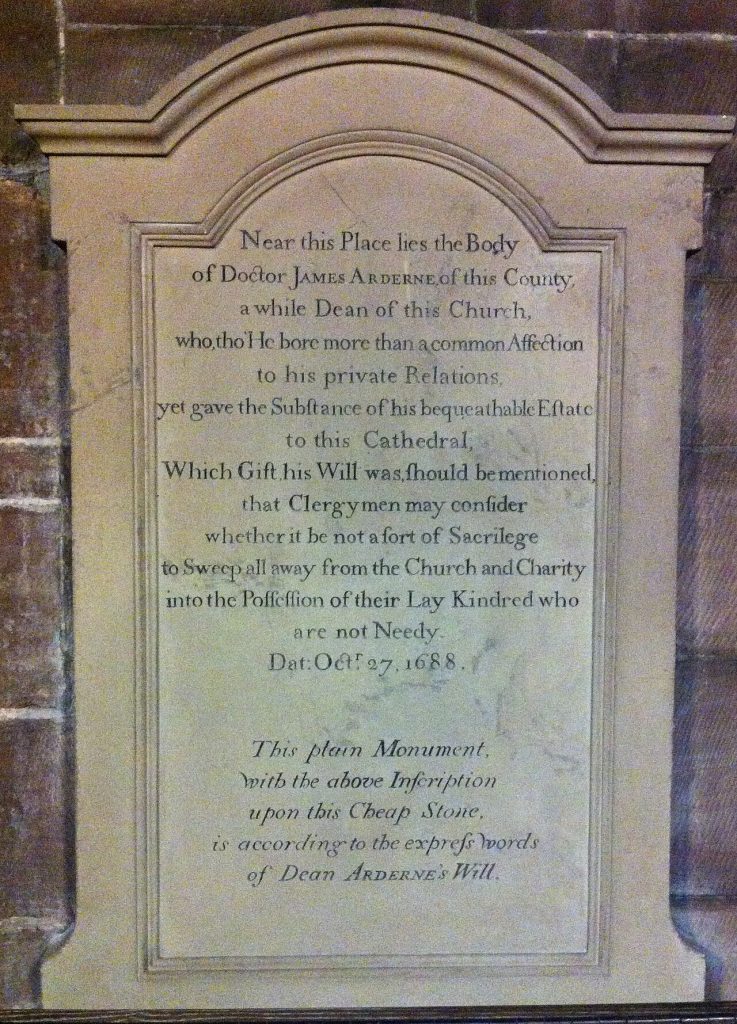
James Arderne died on 18 September 1691 and was buried within Chester Cathedral, where a monument commemorates his contributions. His enduring significance rests primarily upon the foundation of the cathedral library, which survived subsequent centuries of ecclesiastical reform and modernization to remain a vital repository of early printed books and historical manuscripts. Arderne's vision predated the broader eighteenth-century public library movement, marking him as an important transitional figure in the democratization of learning within the English church. Modern historical scholarship continues to examine his sermons, writings, and institutional papers as valuable primary sources for understanding the intellectual climate of Restoration England.
📚 References & Primary Sources
- Oxford Dictionary of National Biography. 'Arderne, James (1636–1691)', Oxford University Press.
- Morrice, J. H. 'The Deanery of Chester: James Arderne and His Library', Journal of Ecclesiastical History, 1954.
- Venn, John. Alumni Cantabrigienses: A Biographical List of All Known Students, Graduates and Holders of Office at the University of Cambridge, Cambridge University Press, 1922.
- External Authority: Chester Cathedral Official Archives →
- External Authority: British History Online →
{“@context”:”https://schema.org”,”@type”:”Person”,”headline”:”James Arderne”,”name”:”James Arderne”,”description”:”Explore the life and legacy of James Arderne (1636–1691), English clergyman, Dean of Chester, and founder of the historic Chester Cathedral Library.”,”inLanguage”:”en”}