Johann Amman
📑 Table of Contents
📊 Fast Facts & Overview: Johann Amman
| Born | December 22, 1707, Schaffhausen, Switzerland |
| Died | December 14, 1741, St. Petersburg, Russian Empire |
| Occupation | Physician, Botanist, Professor |
| Institution | Imperial Academy of Sciences, St. Petersburg |
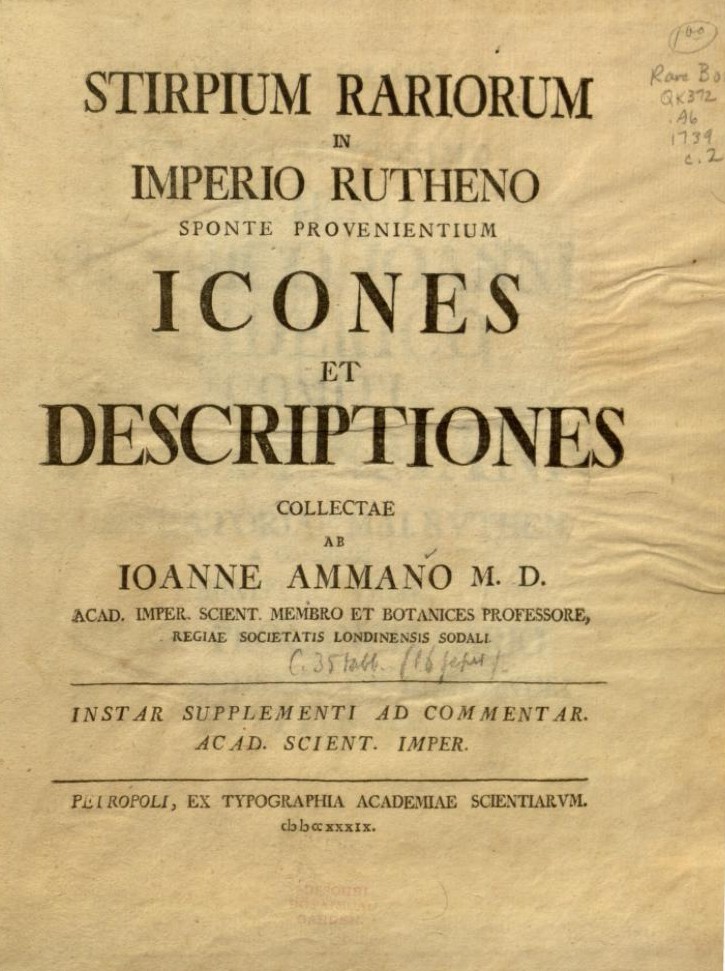
| Notable Work | Stirpium Rariorum Imperii Ruthenici Icones et Descriptiones (1739) |
Johann Amman (22 December 1707 – 14 December 1741) was a Swiss-born physician and botanist who made significant contributions to the scientific exploration of the flora of the Russian Empire. Serving as a professor of botany at the Imperial Academy of Sciences in St. Petersburg, Amman played a pivotal role in organizing the academic botanical collections, corresponding with leading European naturalists of the Enlightenment, and authoring foundational works on Russian plant species.
(adsbygoogle = window.adsbygoogle || []).push({});
1. Background & Historical Origins
Born in Schaffhausen, Switzerland, Johann Amman received his foundational education in medicine and the natural sciences in Leiden under the tutelage of prominent medical figures such as Herman Boerhaave. His academic promise and dedication to botanical taxonomy drew the attention of Hans Sloane, a leading English naturalist and president of the Royal Society, with whom Amman maintained extensive correspondence. In 1733, Amman relocated to St. Petersburg, Russian Empire, accepting an invitation to join the newly established Imperial Academy of Sciences as a professor of botany. This appointment placed him at the frontier of botanical exploration, where vast, largely undocumented territories offered unprecedented opportunities for taxonomic research.
2. Characteristics, Architecture & Analysis
Amman's primary scholarly contribution lies in his rigorous application of the Linnaean and pre-Linnaean taxonomic frameworks to the indigenous flora of Siberia and European Russia. During his tenure in St. Petersburg, he was tasked with curating and expanding the academy's botanical cabinet, incorporating specimens gathered by expeditions across the Russian interior, including those led by Johann Georg Gmelin and Gerhard Friedrich Müller. Amman's methodology combined meticulous morphological description with empirical observation. His crowning achievement, 'Stirpium Rariorum Imperii Ruthenici Icones et Descriptiones' (Icons and Descriptions of Rare Plants of the Russian Empire), published in 1739, featured detailed copperplate engravings and rigorous Latin descriptions of numerous previously unclassified plant species native to Russian domains, thereby bridging Eastern European biodiversity with Western European scientific discourse.
3. Significance, Legacy & Modern Influence
Despite his untimely death at the age of 33, Johann Amman left an enduring legacy in the fields of botany and historiography of science. His active correspondence with prominent European intellectuals, including Carl Linnaeus—who named the genus *Ammania* in his honor—ensured that Russian botanical discoveries were rapidly integrated into broader international scientific networks. Amman's herbarium and manuscripts remain valuable historical artifacts for understanding the systematic documentation of Eurasian flora during the early 18th century, cementing his status as a critical figure in the institutionalization of natural sciences in imperial Russia.
📚 References & Primary Sources
- Stafleu, Frans A., and Richard S. Cowan. Taxonomic Literature: A Selective Guide to Botanical Publications and Collections with Dates, Commentaries and Types. Utrecht: Bohn, Scheltema & Holkema, 1976.
- Stearn, William T. Botanical Latin: History, Grammar, Syntax, Terminology and Vocabulary. Portland: Timber Press, 2004.
- Vitol, A. V. The Imperial Academy of Sciences and the Development of Russian Botany in the Eighteenth Century. St. Petersburg: Nauka, 2011.
- External Authority: Encyclopaedia Britannica Archive →
- External Authority: International Plant Names Index →
{“@context”:”https://schema.org”,”@type”:”Person”,”headline”:”Johann Amman”,”name”:”Johann Amman”,”description”:”Explore the life and work of Johann Amman (1707–1741), a notable Swiss-born physician and botanist renowned for his contributions to Russian botany.”,”inLanguage”:”en”}