Luís Pinto de Sousa Coutinho, 1st Viscount of Balsemão
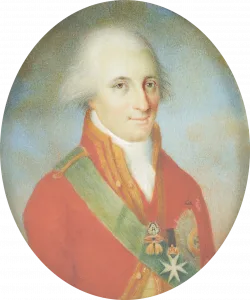
📊 Fast Facts & Overview: Luís Pinto de Sousa Coutinho, 1st Viscount of Balsemão
| Full Name | Luís Pinto de Sousa Coutinho |
| Title | 1st Viscount of Balsemão |
| Birth | 1735, Lamego, Portugal |
| Death | May 5, 1804, Lisbon, Portugal |
| Profession | Statesman and Diplomat |
Luís Pinto de Sousa Coutinho, 1st Viscount of Balsemão (1735–1804) was a Portuguese nobleman, diplomat, and statesman who served as Secretary of State for Foreign Affairs and War, functioning effectively as the head of government during the reign of Queen Maria I. Born in Lamego to an aristocratic family with deep roots in regional administration, Coutinho advanced through the ranks of the Portuguese diplomatic corps, undertaking crucial ambassadorial assignments in London and Madrid before assuming supreme executive responsibilities amidst the geopolitical turbulence of the French Revolutionary Wars.
1. Background & Historical Origins
Coutinho belonged to the high nobility of Portugal, tracing his lineage to prominent military and administrative figures of the northern provinces. His early education emphasized classical humanities, jurisprudence, and foreign languages, which positioned him favorably for a career in royal service. Entering the diplomatic service during the reign of King José I and the ministry of the Marquis of Pombal, Coutinho gained formative experience abroad. His appointment as ambassador to the Court of St. James's in London provided him with a sophisticated understanding of British political economy and international relations, shaping his pro-British diplomatic inclinations that would define his later administrative tenure.
2. Characteristics, Architecture & Analysis
Upon returning to Lisbon, Coutinho rose to prominence within the inner circle of Queen Maria I and the Prince Regent João (later King João VI). In 1788, he was appointed Secretary of State for Foreign Affairs and War, an office equivalent to Prime Minister. His administration was characterized by cautious statecraft aimed at preserving Portuguese neutrality and colonial integrity while navigating the aggressive expansionism of the French First Republic. Coutinho faced severe economic and military constraints, compounded by the disintegration of the traditional balance of power in continental Europe. He oversaw the strengthening of coastal fortifications, attempted fiscal reforms to stabilize the royal treasury, and managed complex negotiations with both Great Britain and Spain regarding Iberian security and colonial boundaries in South America.
3. Significance, Legacy & Modern Influence
In recognition of his distinguished service to the crown, Coutinho was elevated to the peerage as the 1st Viscount of Balsemão by royal decree on December 17, 1790. Although his tenure ultimately concluded prior to the devastating Peninsular War and the 1807 transfer of the Portuguese court to Brazil, his foreign policy framework laid the groundwork for Anglo-Portuguese cooperation during the Napoleonic era. He died in Lisbon in 1804, leaving behind extensive personal correspondence and state papers that remain vital primary sources for historians studying late 18th-century Iberian diplomacy and the structural decline of the *Ancien Régime* in Southern Europe.
📚 References & Primary Sources
- Serrão, Joaquim Veríssimo. *História de Portugal: O Despotismo Ilustrado (1750-1807)*. Editorial Verbo, 1982.
- Maxwell, Kenneth. *Conflicts and Conspiracies: Brazil and Portugal, 1750-1808*. Cambridge University Press, 2004.
- Monteiro, Nuno Gonçalo. *O Ocaso dos Grandes: Poder e Ordem Nobiliarte em Portugal, 1750-1810*. Edições Colibri, 1998.
- External Authority: Portuguese Institute of Archives →
- External Authority: Encyclopaedia Britannica Archive →