Johann Bernoulli
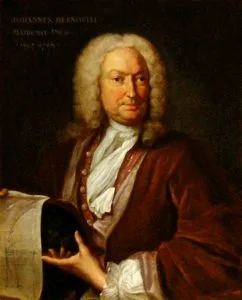
📊 Fast Facts & Overview: Johann Bernoulli
| Born | August 6, 1667, Basel, Switzerland |
| Died | January 1, 1748 (aged 80), Basel, Switzerland |
| Alma mater | University of Basel |
| Notable students | Leonhard Euler, Daniel Bernoulli, Guillaume de l'Hôpital |
| Field | Mathematics, Physics |
Johann Bernoulli (1667–1748) was a Swiss mathematician who pioneered the development of infinitesimal calculus and applied it to mechanics, optics, and differential equations. Alongside his older brother Jakob Bernoulli, Johann was among the earliest to master and propagate the calculus invented by Gottfried Wilhelm Leibniz. He held academic chairs at the University of Groningen and the University of Basel, and he is widely recognized as a foundational figure in 18th-century mathematical analysis through his research and his tutelage of prominent mathematicians such as Leonhard Euler.
1. Background & Historical Origins
Born in Basel, Switzerland, on August 6, 1667, Johann was the tenth child of Nicolaus Bernoulli and Margaretha Schönauer. Originally directed by his father toward a commercial career in the family spice business, Bernoulli showed an early aptitude for classical languages and mathematics. He entered the University of Basel, where he studied medicine, receiving his master's degree in 1685. Under the influence of his brother Jakob, however, Johann shifted his academic focus to the newly formulated differential calculus of Leibniz. The two brothers maintained a rigorous correspondence with Leibniz, quickly mastering the techniques of infinitesimal analysis and applying them to complex physical problems that baffled contemporary mathematicians.
2. Characteristics, Architecture & Analysis
Bernoulli's mathematical output was characterized by prolific problem-solving, foundational textbook authorship, and fierce academic rivalries. In 1691, he traveled to Paris, where he tutored the French nobleman Guillaume de l'Hôpital in mathematics. A financial agreement between the two men later led to the publication of the first calculus textbook, *Analyse des infiniment petits* (1696), which contained the result now known as l'Hôpital's Rule—a theorem actually discovered by Bernoulli. In 1695, Bernoulli accepted a professorship of mathematics at the University of Groningen. During his tenure there, he proposed the brachistochrone curve problem in 1696, challenging the international mathematical community to find the curve of steepest descent under gravity. Solutions provided by Isaac Newton, Jakob Bernoulli, Leibniz, and Johann himself established the foundations of the calculus of variations. Following his brother Jakob's death in 1705, Johann returned to Basel to assume the chair of mathematics, a position he retained for the remainder of his life.
3. Significance, Legacy & Modern Influence
Johann Bernoulli's influence on the dissemination of calculus across Europe was profound. He maintained an extensive correspondence network that bridged the scientific communities of Britain, France, Germany, and Switzerland. As a professor at Basel, he profoundly shaped the trajectory of mathematical physics by educating the young Leonhard Euler, whose own monumental contributions emerged directly from Bernoulli's tutelage. Bernoulli made significant contributions to hydrodynamics, publishing *Hydraulica* in 1739, though he engaged in a controversial priority dispute with his son, Daniel Bernoulli, over the timing of hydrodynamical theorems. Johann Bernoulli died in Basel on January 1, 1748, leaving a legacy as one of the principal architects of modern mathematical analysis.
📚 References & Primary Sources
- C. Truesdell, 'The New Bernoulli Edition', Isis, Vol. 49, No. 1 (1958), pp. 34-38.
- J. O. Fleckenstein, Johann und Jakob Bernoulli, Birkhäuser Verlag, 1949.
- H. J. W.us de Jong, 'The Bernoulli Family: Scientific Dynasty', Historia Mathematica, 1988.
- External Authority: MacTutor History of Mathematics Archive →
- External Authority: Encyclopaedia Britannica Entry on Johann Bernoulli →