
Active Recall: Turbocharge Your Memory
Active recall is a powerful technique that forces your brain to retrieve information from memory, strengthening connections and enhancing retention. Here are some effective active recall techniques:
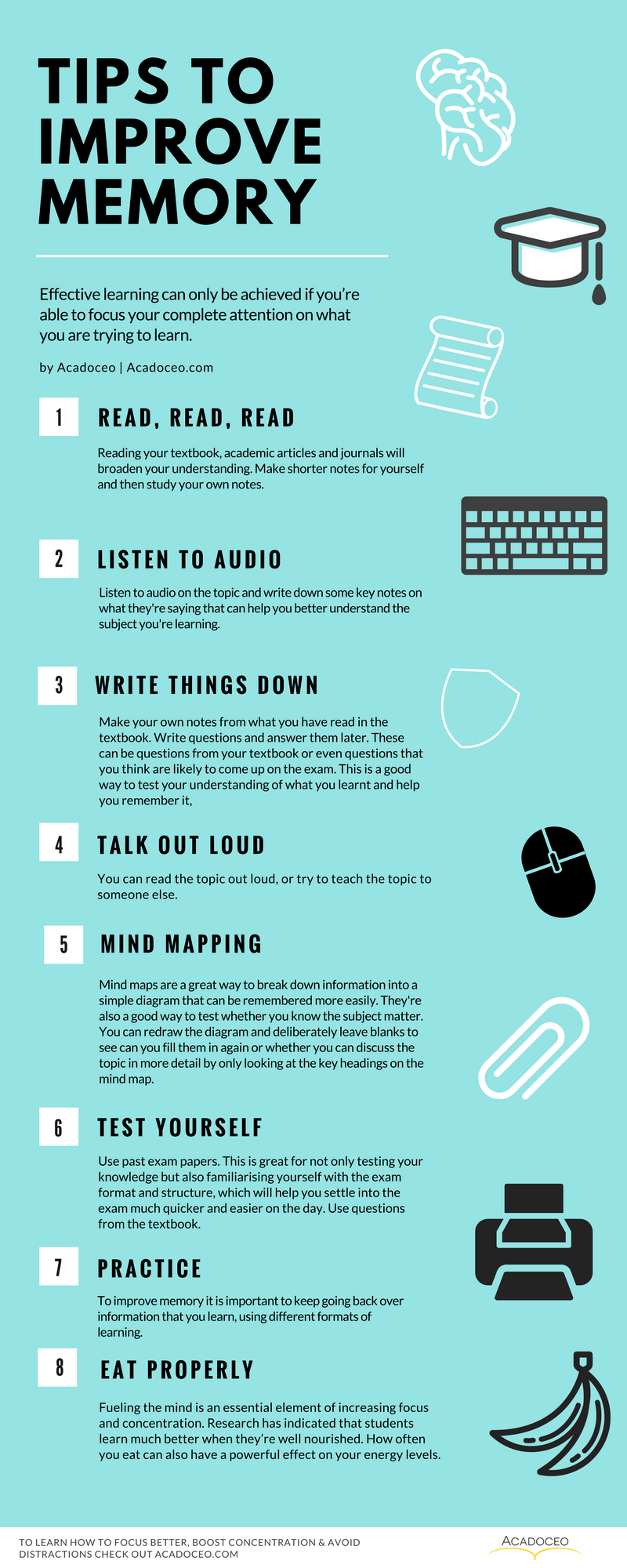
1. Spaced Retrieval:
- Review information at increasing intervals, e.g., 10 minutes, 1 hour, 1 day.
- This forces your brain to work harder to recall, creating stronger memories.
2. Testing Yourself:
- Create flashcards or quizzes to test your understanding.
- Repeated testing helps you identify areas where you need more practice.
3. Teach Someone Else:
- Explain a concept to a friend or colleague.
- This forces you to organize and recall information from memory, solidifying it.
4. Writing Summaries:
- After studying, write a summary of key points without referring to notes.
- This helps you process and synthesize information, improving retention.
5. Free Recall:
- Cover your notes or study materials.
- Try to recall as much information as possible from memory.
- Repeat until you can remember more effectively.
6. Retrieval Cueing:
- Associate information with specific cues or triggers, e.g., a song, an object.
- When you need to recall, focus on the cue to activate the memory.
7. Interleaving:
- Mix different topics or study materials while studying.
- This prevents your brain from relying on rote memorization and forces it to discriminate between concepts.
Benefits of Active Recall:
- Improved Retention: By actively engaging with information, you create stronger memories.
- Increased Confidence: Testing yourself and succeeding builds your confidence in your abilities.
- Enhanced Understanding: Active recall forces you to process and understand information deeply.
- Reduced Cramming: Spaced retrieval and interleaving reduce the need for last-minute study sessions.
- Long-Term Memory: Active recall techniques help you transition information from short-term to long-term memory.
Tips for Effective Active Recall:
- Start with small chunks of information.
- Make it a regular part of your study routine.
- Be patient and persistent.
- Seek support from others if needed.## Boost Your Memory Power: Active Recall Techniques For Retaining Information
Executive Summary
Active recall techniques are powerful tools for boosting memory power and improving information retention. By actively retrieving information from memory instead of passively re-reading it, you can strengthen neural connections and make information more accessible. This article explores five effective active recall techniques that can help you enhance your memory and unlock your full potential.
Introduction
Memory is a complex cognitive process that involves encoding, storing, and retrieving information. While passive methods of learning, such as re-reading or highlighting, can temporarily enhance memory, they often fail to lead to lasting retention. Active recall techniques, on the other hand, engage the brain in a more dynamic and challenging way, promoting deeper understanding and more durable memories.
FAQs
1. What is active recall?
Active recall refers to the process of actively retrieving information from memory without the use of notes or external cues. This involves recalling facts, concepts, or details from memory through techniques such as flashcards, quizzes, or self-testing.
2. Why is active recall more effective than passive learning?
Passive learning methods, such as re-reading or highlighting, often result in shallow processing of information. Active recall forces the brain to engage in deeper processing and retrieval, creating stronger neural connections and enhancing long-term memory.
3. How can I incorporate active recall into my learning?
There are various ways to incorporate active recall into your learning. Some common techniques include flashcards, spaced repetition, self-testing, practice questions, and Retrieval Practice.
Subtopics
Spaced Repetition
Spaced repetition involves reviewing information at increasing intervals. After initially encountering new material, you review it again after a short period (e.g., 10 minutes), then again after a longer period (e.g., 1 day), and so on. This process helps strengthen memories and prevents forgetting.
- Spaced intervals: Determine optimal intervals for review based on the difficulty of the material.
- Progressive increase: Gradually increase the spacing between reviews as memory improves.
- Regular intervals: Adhere to a consistent review schedule to maintain progress.
- Active engagement: Actively recall the information during each review, not just recognize it.
- Testing intervals: Use testing to evaluate progress and identify areas needing additional review.
Flashcards
Flashcards are a classic active recall tool. They involve writing information on one side of a card and the answer on the other. By regularly reviewing the flashcards and trying to recall the answer before flipping them over, you engage in active retrieval and reinforce memory.
- Short concise content: Include only essential information on each card.
- Frequent review: Review flashcards regularly, especially in the initial stages.
- Spaced intervals: Use spaced repetition to optimize review intervals.
- Active recall: Attempt to recall the answer before looking at the back of the card.
- Testing: Quiz yourself on the flashcards to assess memory and identify areas needing improvement.
Self-Testing
Self-testing involves quizzing yourself on the material you are trying to learn. This can be done by creating practice questions, taking mock exams, or simply going through the material in your head and trying to recall the information.
- Regular testing: Conduct self-tests frequently to reinforce memory.
- Closed-book testing: Test yourself without referring to notes or resources.
- Varied formats: Use different testing formats (e.g., multiple-choice, short answer, essay) to enhance retention.
- Immediate feedback: Provide yourself with feedback on your performance to identify strengths and weaknesses.
- Realistic conditions: Test yourself in conditions that resemble real-world scenarios to prepare for practical applications.
Elaboration
Elaboration involves connecting new information to existing knowledge and experiences. This helps create meaningful links between concepts and strengthens memory. Elaboration techniques include explaining concepts to others, generating examples, and making analogies.
- Personal connections: Relate new information to your own experiences and prior knowledge.
- Examples and analogies: Use examples and analogies to illustrate and clarify concepts.
- Teaching others: Explain the material to others to reinforce understanding and identify areas needing further clarification.
- Interconnections: Link new information to other related concepts and ideas.
- Visual aids: Use diagrams, charts, or mind maps to create visual representations of the material.
Retrieval Practice
Retrieval practice refers to the repeated attempt to retrieve information from memory. This can be done through various methods such as flashcards, self-testing, or simply recalling information during a lecture or presentation.
- Regular retrieval: Regularly access information from memory to strengthen recall.
- Varied methods: Use different methods to retrieve information (e.g., writing, speaking, drawing) to enhance retention.
- Increased difficulty: Gradually increase the difficulty of retrieval activities to challenge memory.
- Immediate feedback: Provide yourself with feedback on retrieval attempts to identify areas needing improvement.
- Spaced intervals: Review information at increasing intervals to promote long-term memory.
Conclusion
Active recall techniques offer a powerful approach to boosting memory power and improving information retention. By actively retrieving information from memory, you can strengthen neural connections, enhance understanding, and create more durable memories. Incorporating these techniques into your learning process can significantly improve your academic performance, professional development, and overall cognitive abilities.