Advantages of Automated Grading and Feedback in Education:
1. Efficiency and Time-Saving:

- Automates grading processes, freeing up instructor time for other tasks.
- Reduces the burden of manual grading, allowing instructors to focus on providing quality feedback.
2. Accuracy and Consistency:
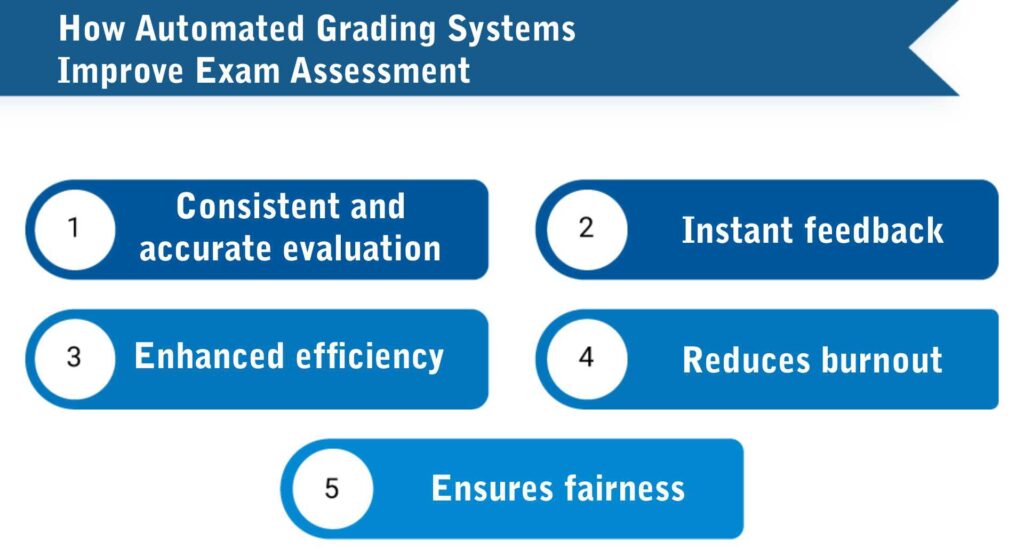
- Eliminates human error and bias in grading.
- Ensures consistent grading standards across students and assignments.
3. Real-Time Feedback and Insights:
- Provides immediate feedback to students, allowing them to identify areas for improvement.
- Helps students understand their strengths and weaknesses more effectively.
4. Data-Driven Decision Making:
- Collects detailed data on student performance.
- Provides insights into student progress, learning styles, and areas where additional support is needed.
5. Personalized Learning:
- Tailored feedback can be provided to individual students based on their specific needs and learning patterns.
- Encourages students to take ownership of their learning process.
6. Reduced Grading Bias:
- Eliminates subjective bias that can be introduced by human graders.
- Ensures that students are evaluated fairly and impartially.
7. Accessibility and Flexibility:
- Online platforms provide 24/7 access to automated grading and feedback.
- Offers flexibility for students to complete assignments and receive feedback at their own pace.
8. Scalability:
- Handles large student cohorts effectively, enabling efficient grading and feedback provision.
- Supports personalized learning for a significant number of students.
9. Cost-Effective:
- Reduces the need for human graders, potentially saving educational institutions time and resources.
- Can eliminate the need for physical grading materials and postage costs.
10. Improved Student Engagement and Motivation:
- Real-time feedback helps students identify learning gaps and take corrective actions.
- Motivates students by providing clear and timely insights into their progress.## The Advantages Of Automated Grading And Feedback In Education
Executive Summary
Automated grading and feedback (AGF) is a rapidly growing field in education. AGF systems use artificial intelligence (AI) to automatically grade student work and provide feedback. This can save teachers a significant amount of time, and it can also help students to learn more effectively.
Introduction
In today’s fast-paced world, educators are constantly looking for ways to improve the efficiency of their grading and feedback processes. Automated grading and feedback (AGF) systems offer a number of advantages over traditional methods, including:
- Increased efficiency: AGF systems can automatically grade student work in a fraction of the time it takes to grade it manually. This frees up teachers to spend more time on other tasks, such as providing individualized feedback to students.
- Improved accuracy: AGF systems are not subject to the same biases as human graders. This can lead to more accurate grading, which can benefit students and teachers alike.
- Increased consistency: AGF systems apply the same grading criteria to all students, which can help to ensure that students are treated fairly.
- Enhanced feedback: AGF systems can provide students with immediate feedback on their work. This feedback can help students to identify their strengths and weaknesses and to improve their work over time.
FAQ
- What is AGF?
AGF is a rapidly growing field in education. AGF systems use artificial intelligence (AI) to automatically grade student work and provide feedback. This can save teachers a significant amount of time, and it can also help students to learn more effectively.
- How does AGF work?
AGF systems use a variety of AI techniques to automatically grade student work and provide feedback. These techniques include natural language processing, machine learning, and computer vision.
- What are the benefits of AGF?
AGF systems offer a number of benefits over traditional grading methods, including increased efficiency, improved accuracy, increased consistency, and enhanced feedback.
Subtopics
1. Time Savings
One of the biggest advantages of AGF is that it can save teachers a significant amount of time. AGF systems can automatically grade student work in a fraction of the time it takes to grade it manually. This frees up teachers to spend more time on other tasks, such as providing individualized feedback to students.
- Reduced grading time: AGF systems can grade student work in a matter of seconds, freeing up teachers to spend more time on other tasks.
- Increased efficiency: AGF systems can help teachers to be more efficient with their time by automating the grading process.
- Improved teacher productivity: AGF systems can help teachers to be more productive by freeing up their time to focus on other tasks.
- More time for students: AGF systems can give teachers more time to spend with students, providing individualized feedback and support.
2. Improved Accuracy
Another advantage of AGF is that it can help to improve the accuracy of grading. AGF systems are not subject to the same biases as human graders. This can lead to more accurate grading, which can benefit students and teachers alike.
- Eliminated subjectivity: AGF systems use objective criteria to grade student work, eliminating the subjectivity of human graders.
- Reduced errors: AGF systems are less likely to make errors than human graders, leading to more accurate grading.
- Fairer grading: AGF systems apply the same grading criteria to all students, ensuring that students are treated fairly.
- Increased student confidence: When students know that their work is being graded fairly, it can boost their confidence in their abilities.
3. Increased Consistency
AGF systems can also help to increase the consistency of grading. AGF systems apply the same grading criteria to all students, which can help to ensure that students are treated fairly. This can also help to reduce the amount of grade inflation that occurs in some classrooms.
- Uniform grading standards: AGF systems ensure that all students are graded using the same criteria, leading to more consistent grading.
- Reduced grade inflation: AGF systems can help to reduce grade inflation by ensuring that all students are graded fairly.
- Increased fairness: AGF systems can help to increase fairness in grading by eliminating the subjectivity of human graders.
- Improved student understanding: When students know what to expect from their grades, it can help them to better understand the grading process and to improve their work.
4. Enhanced Feedback
AGF systems can provide students with immediate feedback on their work. This feedback can help students to identify their strengths and weaknesses and to improve their work over time. AGF systems can also provide teachers with insights into student learning, which can help them to improve their teaching.
- Immediate feedback: AGF systems can provide students with feedback on their work immediately after it is submitted.
- Personalized feedback: AGF systems can provide students with personalized feedback that is tailored to their individual needs.
- Actionable feedback: AGF systems can provide students with actionable feedback that they can use to improve their work.
- Improved student learning: AGF systems can help students to learn more effectively by providing them with immediate and personalized feedback.
5. Other Benefits
In addition to the four main advantages discussed above, AGF systems also offer a number of other benefits, including:
- Reduced workload for teachers: AGF systems can reduce the workload for teachers by automating the grading process.
- Increased student engagement: AGF systems can increase student engagement by providing them with immediate feedback on their work.
- Improved communication between teachers and students: AGF systems can improve communication between teachers and students by providing a platform for feedback and discussion.
- Data-driven insights for teachers: AGF systems can provide teachers with data-driven insights into student learning, which can help them to improve their teaching.
Conclusion
AGF systems offer a number of advantages over traditional grading methods, including increased efficiency, improved accuracy, increased consistency, and enhanced feedback. As AGF systems continue to evolve, they are likely to become even more valuable tools for educators.
Keyword Tags
- automated grading and feedback
- AGF
- AI
- education
- grading
- feedback