Abbreviations and Symbols for Efficient Note-taking
Executive Summary
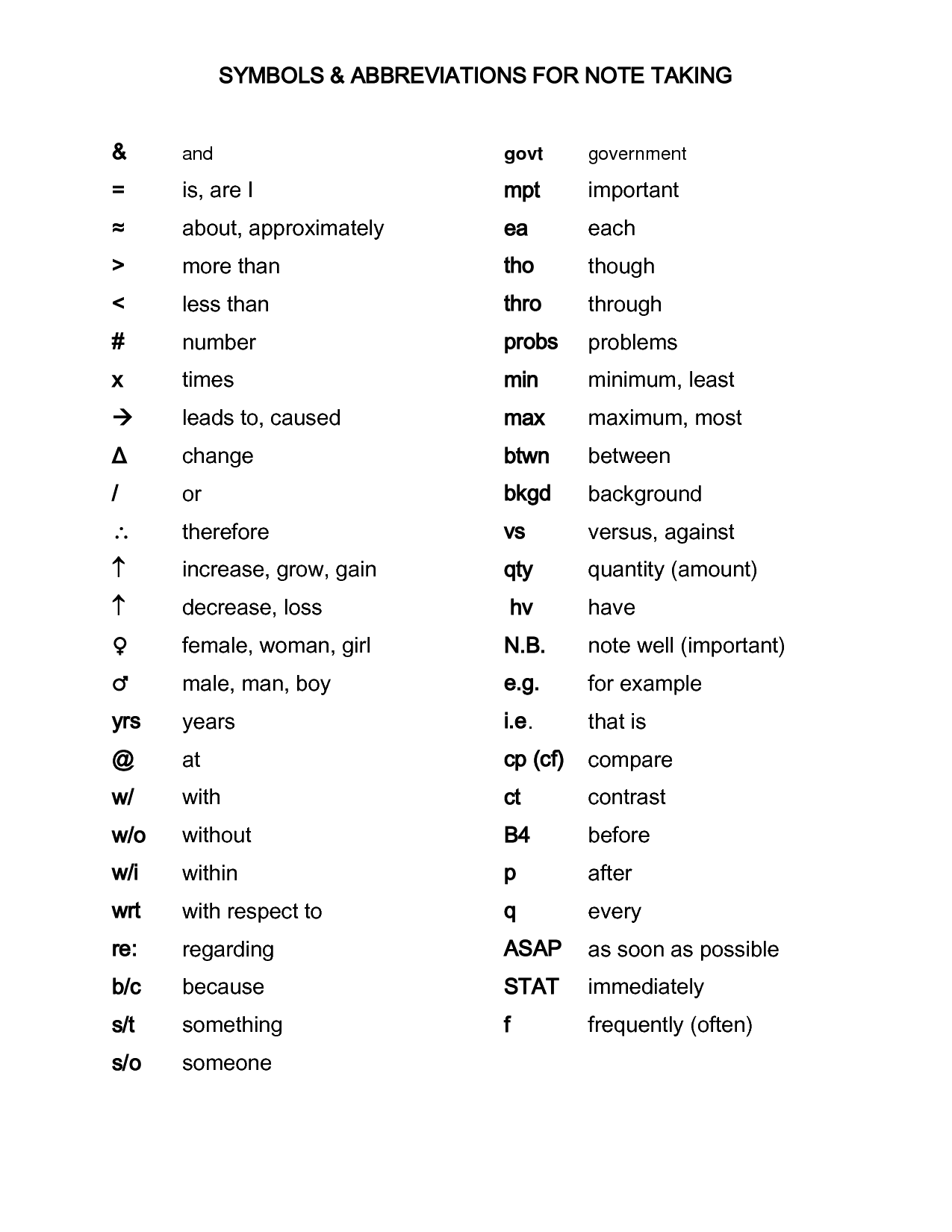
Utilizing abbreviations and symbols during note-taking significantly enhances efficiency, streamlines information, and supports effective recall. This article presents a comprehensive guide to the most widely used shortcuts and symbols, empowering note-takers to maximize their note-taking capabilities and optimize their learning and note-taking processes.
Introduction
In the fast-paced academic or professional environment, capturing information concisely and accurately is essential. Abbreviations and symbols provide an effective solution, enabling note-takers to condense information, convey complex concepts, and facilitate rapid understanding and recall. This comprehensive article introduces the most useful abbreviations and symbols for efficient note-taking, empowering individuals to elevate their learning and productivity.
FAQs
1. What are the benefits of using abbreviations and symbols in note-taking?
- Enhances efficiency and speed of note-taking
- Condenses information, saving space
- Improves readability and organization
- Aids in quick retrieval of information
- Facilitates effective recall and understanding
2. What is the most important factor to consider when choosing abbreviations and symbols?
Consistency is paramount. Ensure abbreviations and symbols are used uniformly throughout the notes to maintain clarity and avoid confusion.
3. Is there a universal set of abbreviations and symbols for note-taking?
While some abbreviations and symbols are widely recognized, there is no universal set. Different fields and disciplines may adopt their own conventions. It is recommended to establish a customized system that aligns with specific note-taking needs and preferences.
Top 5 Subtopics
Acronyms
Acronyms are formed using the initial letters of a phrase or term. They are widely used in technical, academic, and industry-specific settings.
- Important pieces:
- NATO (North Atlantic Treaty Organization)
- LASER (Light Amplification by Stimulated Emission of Radiation)
- FAQ (Frequently Asked Questions)
Contractions
Contractions are shortened forms of words, typically formed by omitting letters or syllables.
- Important pieces:
- Can’t (cannot)
- Don’t (do not)
- Won’t (will not)
Symbols
Symbols are graphical representations of concepts or ideas. They are commonly used in mathematics, science, and engineering.
- Important pieces:
- (plus)
- (minus)
- x (multiplication)
- ÷ (division)
Arrows
Arrows indicate direction, relationships, or connections between different pieces of information.
- Important pieces:
- → (points to)
- ← (points back)
- ↑ (points up)
- ↓ (points down)
Brackets
Brackets are used to group or enclose specific information, such as examples, explanations, or additional notes.
- Important pieces:
- [ ] (square brackets)
- ( ) (parentheses)
- {} (curly brackets)
Conclusion
Incorporating abbreviations and symbols into note-taking practices is a powerful strategy to enhance efficiency, improve understanding, and maximize information retention. By familiarizing themselves with the most commonly used shortcuts and symbols, note-takers can streamline their note-taking process, optimize their note-taking capabilities, and achieve greater academic and professional success.
Keyword Tags
- Note-taking
- Abbreviations
- Symbols
- Efficiency
- Learning